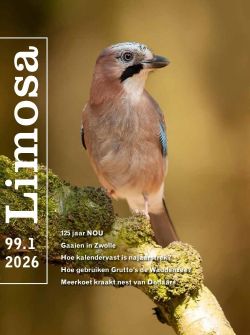
Ondřej Belfín, Roeland A. Bom, Jan de Jong, Jan Ellens & Theunis Piersma (2026) How do Black-tailed Godwits Limosa limosa limosa exploit the Wadden Sea? First results from tagged island birds. LIMOSA 99 (1): 30-38.
During the breeding season in the Netherlands, Black-tailed
Godwits are traditionally considered meadow specialists.
Whilst their use of coastal wetlands is well documented
outside the breeding season, their reliance on intertidal
habitats during breeding has remained unclear, partly
due to limitations in the spatial and temporal resolution
of earlier tracking data. In spring 2024, three Black-tailed
Godwits, breeding on the Dutch Wadden Sea Islands
(named “Elzenhoeve” and “Apollo” on Ameland; and
“Pootjes” on Terschelling) were fitted with high-resolution
GPS-GSM tags recording positions at 10-minute intervals.
Locations were classified into habitat types: intertidal
mudflats, salt marshes, island pools and meadows.
All individuals spent several nights at inland pools or
mudflats in addition to meadows during the chick-guiding
period and exhibited increased spatial mobility after chick
loss or the fledging of chicks. Elzenhoeve (Fig. 2a, 2b)
and Apollo (Fig. 3a, 3b) made repeated visits to intertidal
mudflats, with their movement patterns clearly aligned
with tidal cycles. This suggests active foraging on mudflats.
Pootjes avoided intertidal zones, but regularly used
supralittoral salt marshes and island pools (Fig. 4a, 4b).
Notably, Elzenhoeve started its southward migration 18
days later than Apollo, during which it remained in coastal
areas near the town of Harlingen and continued to follow
the tidal regime closely.
These findings indicate that intertidal and saltmarsh
habitats serve an important post-breeding function for
some Black-tailed Godwits in the Dutch Wadden Sea region,
revealing a greater degree of behavioural flexibility in habitat
use and migration timing than previously assumed. Further
tracking, particularly of mainland godwits near the Wadden
Sea, will help determine the extent of this behaviour and
whether it is primarily motivated by food availability,
predation avoidance, disturbance, or social cues.
[pdf only for members] [dutch summary]
|